Showing posts with label Matcha. Show all posts

Wednesday, March 19, 2008

O-cha's Organic Matcha Kaoru

Matcha Kaoru is grown in Aichi, a prefecture just west of Shizuoka. Kaoru means fragrant. This one is meant for usucha.


Aroma: 6/10
Sweetness: 7.5/10
Astringency: 0/10
Flavor 7/10.

The aroma is not as fragrant as some of O-cha's other matcha, like the Kiku or Chiyo Mukashi, but it has a pleasant depth, fresh and sweet.

The first words that come to mind when I sip it are sweet, yummy, fresh. It has a warm and thick mouth-feel, quite sweet and smooth. I think this a fantastic usucha. At this point I've now had all of O-cha's matcha save for the organic Kaoru Supreme, and I must say their matcha is consistently fresh and superior with prices more than fair for the quality. Theirs is the best I've had.


Preheating

If you desire a good head, preheating the chawan is a must. For me it is a simple part of the routine.

I pour boiled water into my yuzamashi, then from the yuzamashi into the chawan and over the chasen, then I refill the yuzamashi and allow the water to cool. This rinses any dust off my utensils and preheats the bowl and chasen. Preheating the chasen helps keep the tines from breaking and will prolong its life.


It is also important to dry the bowl before adding the matcha. I was asked about this earlier today. If you put matcha into a wet bowl, there is a good chance that it will turn into paste, and you wont get a through mix. Yes you can correct this by whisking harder or scraping the chasen along the bottom, but I feel this puts unnecessary wear and tear on what is a rather delicate utensil.

Once I am done rinsing, drying, and have scooped out the desired amount of matcha, the water in the yuzamashi should be at a good temperature.

Remember, I do not claim to be an expert or that my way is the only way. I only add these suggestions on matcha preparation in hopes that someone else might learn from my mistakes, my trial and error.
_________
To give you an idea of the camera I'm working with, and what a difficult time I have trying to get the colors of the matcha to come out, those flowers in the pictures are actually purple.

Tuesday, March 18, 2008

Matcha Source Matcha Kinrin and Matcha Sifter

As their name indicates, Matcha Source provides matcha and matcha accessories from a variety of other shops. Since they are a reseller, you will pay more for their products, so if you choose to purchase something from them, I recommend taking note of which shop they sourced it from, and buying it direct. For example:

Matcha Kinrin:
M.S. Price: $20 vs Koyamean Price: $12

Matcha Sifter:
M.S. Price: $14 vs Ippodo Price: $8.65

On the other hand, if you were looking to buy a variety of items that came from different shops, I could see that it might be more convenient, and possibly less expensive once shipping charges were taken into account, to simply purchase it all from one place.

The Matcha Kinrin, "Profound," comes from Koyamaen. It is meant for koicha.


Aroma: 6/10
Sweetness: 4/10
Astringency 1-3/10
Flavor 5/10

This was an average matcha, but quite fair for the original price. It has decent flavor; I still find it hard to describe the taste of matcha. It isn't grassy or vegital or like any other green tea. It isn't nuanced or layered either. The kinrin has a pleasant creamy mouth feel. I would consider this one a very suitable daily koicha, provided you buy it from Koyamaen.


The preparation instructions that came with the tea were helpful. Matcha Source suggests using an almond-sized scoop. I thought this was as good a visual as any, so here you go:


Use about that much. If you don't have a chashoku, this comes to .5-.6 grams. Two scoops equals about a teaspoon.

Matcha Sifter


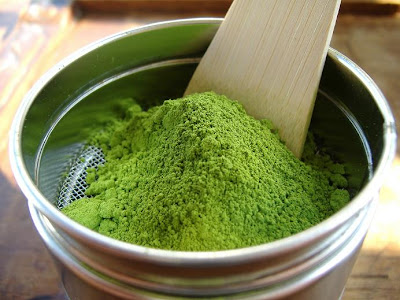
Also known as a matcha burui (sieve). The sifter is removable and comes with a small, bamboo spatula. The container is air tight and will hold up to 50 grams. I have used it twice now, sifting an entire 20-30 gram tin at a time. The matcha will re-clump a bit given time, but not enough to make a difference.


So far I am fond of it. I have had no problems with it, and I prefer having my matcha pre-sifted. Do follow their cleaning instructions. I thought I was smarter than them and made a mess. Matcha and water equals green mud, gooey, hard to clean, mud.

Wednesday, February 27, 2008

Den's Tea Matcha Miyabi

The Miyabi is the highest grade matcha that Den's Tea offers.


According to Wikipedia, Miyabi is a traditional Japanese aesthetic ideal that "demanded the decline of anything that was absurd or vulgar and the 'polishing of manners, diction, and feelings to eliminate all roughness and crudity so as to achieve the highest grace."

This matcha should be used for koicha (thick tea).


Aroma: (5/10 - and that's being a little generous) The fragrance was typical but subdued.

Sweetness: (6.5/10) It has decently sweet characteristics, you just have to be sure to use enough.

Astringency: (1/10) It's as smooth as can be, not the slightest bit of astringency or bitterness.

Flavor: (5/10) Like the Kaze this tea was very mild, and I simply prefer my matcha to have some umph to it. Even when using more, 5-6 scoops vs the traditional 3-4, it only serves to add a smokey throatiness, but fails to increase the over all flavor.

Again, like the Kaze, this matcha comes from Shizuoka instead of Uji. I will keep an eye out for another Shizzy matcha from a different vendor to see if the Kaze and Miyabi are typical examples of that region, but in the meantime, if you like lots of flavor in your matcha, I recommend giving Den's a pass.


Whisking, if you care about this kind of thing.

I have been told when whisking matcha, part of the idea is to avoid large bubbles. Of course this is more of an aesthetic concern, because as long as you whisk the matcha thoroughly, it won't effect the taste one way or the other.

I have found the best way to avoid large bubbles in the froth is to use deliberate strokes, fast at first, then slow. You're not beating eggs.


Kickboxing Geishas
How Japanese Women are Changing Their Nation

The title alone sold me on this book.

I have become deeply interested in gender roles, so I enjoyed this book a great deal. While the author, Veronica Chambers, focuses on the diverse and changing lives of women in Japan, since it is impossible to define gender roles without exploring both sides, you learn about the part Japanese men must play as well. Chambers does a wonderful job of providing a fair illustration of the complex relationship between men and women, both in the corporate world and in their personal lives.

I learned a variety of things along the way, parasite singles (people who live with their parents, who support them, well into their late 20's or 30's ), Narita Rekon (newlyweds getting divorced as soon as they return from the honeymoon, because the wife realises just what her husband is like, thus ditches him at the airport upon their return), and Japans ostentatious costume culture, from hip hop to "Lolitas." Chambers also explores how unique aspects of Japanese culture make certain things that we take for granted, like dating, problematic.

It was a very good book, very enjoyable. Learning more about someone's culture, helps us to better understand our own.

Monday, February 4, 2008

O-cha's Matcha Chiyo Mukashi

Ocha's Chiyo Mukashi, a wonderful birthday present from my in-laws, is from Uji. According to Kevin the name translates as chi: one thousand, yo: era or period, mukashi: long ago, ancient.

I had just opened a fresh tin of Nakai's Uji Matcha, so I planned to wait a while before opening it. My self-control lasted twelve, maybe sixteen hours, eight of which I was asleep. Go will-power.

This matcha is meant for koicha, but can be used for usucha. I found usucha to be too mild for this tea, so the following notes are for koicha.

Aroma: (9/10) Strong, you open it and seconds later you can smell it. Sweet, thick. Vegetal; I shit you not, I smell...french fries or veggie chips. I think my brain, when encountering a new, unknown smell, simply spins a wheel and picks whatever random association the needle stops on.

Sweetness: (3/10) Not very sweet.

Astringency: (5-7/10) This is the most astringent matcha I've had yet. If I prepare it using Hibiki's koicha instructions, it is very astringent, I can feel it predominantly on the sides of my tongue. If I use O-cha's koicah instructions, its dialed down a bit, and I can feel it in the back of my throat.

Flavor: (7/10) This is a distinctive matcha, with a clear vegetal profile that helps it stand out. It is bold and clean. As I said, I found usucha was too mild, but koicha is just a smidgen more astringent than I prefer. I think three scoops is a good compromise, and yields a more enjoyable bowl.

Sifting

Sifting the matcha is a must in my opinion. I have my eye on one of these matcha sifters, but in the mean time, I have been experimenting with different methods.

Most of the time I use one of these brew baskets to sift the matcha as I go, using the chashoku as a paddle, sort of a back and forth sweeping motion. It works quite well. The baskets are durable and easy enough to rinse or wash afterwards.

I read about using the chasen to break apart the clumps and sift the matcha in the bowl, using the tines in a chopping motion, kind of like you're preparing lines of coke. This way is a little quicker, but the matcha tends to stick to the tines.


Either method produces the same, positive results in the end.

Friday, January 11, 2008

Den's Tea Matcha Kaze

Kuro Raku

First I'd like to introduce my new chawan, an early birthday present. It is a kuro (black) raku made in Tokoname, Japan by Shoraku.


I was interested in this one from Hibiki-an, but I wanted to continue to pursue my business relationship with Toru-san from Artistic Nippon. I emailed him a picture of it and asked if it was something he could procure for me, and of course he came through for me again. I think he did an excellent job, and I am very pleased with it.

Interesting coincidence: both bowls have the artist's chop in gold paint/glaze; however, the picture I sent Toru-san did not show the chop, so he couldn't have known.

Matcha Kaze

This is my first matcha from Den's Tea and my first from Shizuoka.

Matcha has been the most challenging tea to review so far. The vocabulary isn't as established as it is with most tea. I know from reading blogs and what not that with other teas I can expect notes of chocolate or peach, camphor or muscatel, grassy or nutty, whatever the case may be. Realizing that I can bull shit you with vague talk of "green" and "fresh" for only so long, I tried to find other, more descriptive words.

The obvious idea was to look at blogs, see how others describe matcha, but it turns out that unless I plan to bake with it or make frappucinos, I'm out of luck. (If you're reading this, and I missed your brilliant posts on the complex, umami deliciousness of matcha, please leave a link in the comments). In the end I browsed through a few Japanese sites like Ippodo and Hibiki-an, putting together my own list of characteristics, a bit of a scale to help quantify my results.

Checklist isn't the right word, but its the first one that comes to mind.

Aroma: (7/10) It is rich and sweet but subdued compared to the Uji matcha that I've primarily used thus far.

Sweetness: (5/10) Moderate, towards the end it tasted a bit dry.

Astringency: (1/10) Even when using much larger amounts than is recommended for usucha, which I will get to in a sec, I wouldn't describe it as even lightly astringent.

Taste: (6.5/10) Mild would be the most concise word. Not bad or inferior, but not intense or bold. It was clear early on that the 1.5 - 2 scoops wasn't going to cut it for me, too weak, so I increased it to 4-5, koicha quantity. Better, but still as I said, mild. In a way I think this is a testament to the quality of the tea. A low grade usucha should have been bitter, harsh or unpleasant after that amount.

Ultimately this tea wasn't for me, but only because I have to use so much, otherwise it would be a suitable daily matcha. I will try Den's other Shizuoka matcha, the Miyabi, on my next order. I am curious if other Shizuoka matcha is like this.

Every time I make matcha, I learn something. This time it was Don't prepare matcha next to an open window. That green stuff can get every where. For sure I am still going to find it on some of my books months from now. This is funny given the name. Kaze means wind.

Sunday, January 6, 2008

Rishi Matcha

After I posted my review on Rishi's sweet matcha, my rep. sent me an email at work about it, providing more information about the product (the sugar to matcha ratio is 9 to 1), and offering to send me further samples of their matcha line.

My opinion on the Sweet Matcha has not changed with further experimentation. Its just too much sugar to enjoy. The "straight" matcha was more...useful.

It comes packaged in twenty, single-serving wrappers, which are ideal for tea-to-go, convenient. Simply add the tea to a bottle of water, shake, shake, shake, and you have a bottle of RTD tea that is far better than what you can buy at a store. I plan to experiment further with powdered sencha and other teas in the future. I think this may be the answer to my lack of tea at work.

Traditional preparation is where the lack of quality becomes apparent, though to be fair, it has had some tough competition. The wrappers, which are convenient on the go, aren't ideal in this setting. One serving is too much tea for the traditional 3-4 oz of water. The resulting bowl was harsh, overly astringent. Next I emptied a few into a makeshift natsume, scooping out the desired amount, but it didn't taste as fresh, the flavor, diminished.

I don't like posting negative reviews, but Rishi's Matcha was important in establishing a reference point, for me and for my readers. Previously, all the matcha I had been drinking was O-cha's; I had nothing to compare it to, but now I can begin to create a larger frame of reference.

They also sent an ounce of Chiyo Sakae. I have never seen it offered on their website, so I'm not sure what the story is there, if this is something they plan to offer in the future. It was better, not great, but a passable daily matcha, something to sustain me during dry spells.

Wednesday, December 5, 2007

Uji Matcha Manten


The Manten comes from O-cha via Tsuen, Japan's oldest tea shop, and at $60 for 30 grams, this is the most expensive tea I've purchased. Manten is a koicha (thick tea), and it comes from bushes at least 30 years old, grown in Uji by a distinguished gentleman who has won awards for his Tencha.

The Manten comes in an elegant and simple tin with an inner plastic lid that keeps it air tight.

Making it for the first time was an experience. The timelessness of tea, the fusion of history and culture, has always been the primary appeal for me, but never before had it been this poignant, preparing tea from a family that has been growing and selling tea for 23 generations and using a chasen that was crafted by another family that has been making them for 35o years. I got kind of tingly.

Properly preparing matcha can be problematic and requires a little practice, mainly because with a chashoku and a samashi you have to eyeball the corect amounts to use. I have found that if you use too little water or too much matcha, the tea will become thicker and sour.

I've had more experience now, and I must stress the importance of sifting the matcha first; it will clump much less and always seems to taste better when you do. Unsifted matcha has the consistency of talcum powder, while sifted matcha will have a homogeneous, sandy texture.

Again, for koicha use 3-4 scoops and 3-4 oz of water.

The Manten tastes very green. I made same for Molly's friend, and she said the same thing. It is flavorful, bold, not quite sweet, but definitely not brassy or astringent. Quite smooth, but I didn't notice that at first, only later, after I drank some lower quality matcha that was rather harsh, then went back to the Manten.

Other than that the Manten was too much for my palate. In the same way it was difficult for me to discern or describe the differences between the Kiri no Mori and the Kiku Mukashi, I can not adequately distinguish the Manten from the Kiku Mukashi. I am not experienced enough yet, as this was only my third matcha.

Honestly this is a relief; I can not afford a regular supply of the Manten at this time, and I am pleased that it hasn't ruined me for all lesser matcha.

Sunday, November 11, 2007

Matcha, Part 4

Sweet Matcha

A few weeks back, Rishi started offering a line of Sweet Matcha. Since then there has been a recurring, morbid interest in it on TeaChat, so I took it upon myself to trek out to Whole Foods and see what it's all about.

The Original Swet Matcha isn't anything new for Rishi, though the packaging is new, and I've never seen it advertised on their website, but it has been part of their Bulk Tea program for some time. I first saw this stuff a year or so ago on an old order guide. The sweet matcha is a mix of matcha and milled cane sugar. I don't know the sugar to tea ratio, but I'd guess at least 50/50.

The color is rather pale, reminds me of dried peas. As to be expected, the aroma was faint.

I used one scoop per ounce of water, and whisked thoroughly, but it wouldn't froth. I suppose because of the high sugar content.

It tastes....I probably have customers who would love this, but I found it very unpleasant, and very, very sweet. A mouth full of warm sugar followed by the distinct taste of matcha. This is not something that I would drink.

However, I looked at their website later, and it would seem that they do not intend this stuff for traditional consumption either. 125 grams for $10? I think its safe to call this food grade matcha.

And sure enough, look at that; they have recipes.

Saturday, November 10, 2007

Matcha, Part 3

Kiri no Mori and Kiku Mukashi

They both come from O-cha, and both are grown in Uji. Uji, near Kyoto, was the birhtplace of tea cultivation in Japan. While not always the case, matcha produced in Uji is often superior.

This is an amazing tea, its preperation and consumption unique and unlike any other. From the moment I begin boiling the water till the last drop, I find myself completely engaged in the task at hand. There is little or no waiting, each step flows effortlessly into the next. I better understand the marriage of cha no yu and Zen, the art and practice of continuously committing oneself to the moment.

I covered the preparation of matcha earlier this week, but I left out sifting, mostly because I was still having mixed results at the time. I got the kinks worked out, and I did notice an improvement. It seems to produce a thicker foam and a more thorough consistency. You can purchase a sifter for your matcha, as I will do eventually, but a brew basket will work as well.

The first thing I always notice is the aroma, just a moment after I open the can, green and sweet. The Kiri no Mori has a slight vegetal smell, where as the Kiku Mukashi does not.

Usucha (2 scoops/3-4 oz)

It is hard for me to tell the two apart. Both are sweet, thick but mild, and thoroughly smooth, no astringency or bitterness.

Koicha (3-4 scoops/2-3 oz)

The Kiku Mukashi, a higher quality matcha that "borders on the threshold between the koicha and usucha." I experimented with different methods of preparing koicha. The directions I found on Ippodo pushed the Kiku Mukashi to its limits. Intense, but unpleasant, becoming more astringent than I like my tea to be.

Tonight I tried to remember the instructions that came from O-cha, and used 4 large scoops with 3 oz of water, and the result was outstanding. Certain nuances emerged that weren't there before, and it developed a pleasant bit of astringency that gives the tea texture.

Thursday, November 8, 2007

Matcha, Part 2

Raku Yaki

"Ichi Raku, ni Hagi, san Karatsu." -a Japanese expression: First Raku, second Hagi, third, Karatsu, essentially affirming the superiority of Raku yaki. Of course, art apreciation is always subjective.

Raku yaki originated towards the end of the 16th century in Kyoto, during the rule of Toyotomi Hideyoshi, by Sasaki Chojiro, a tile maker who enjoyed the patronage of Sen no Rikyu. Chojiro's chawans sought to embody the essence of wabi cha, Rikyu's fusion of the cha no yu with the aesthetic ideals of wabi sabi.

The briefest explanation of wabi sabi I can offer is finding beauty in the impermanence and imperfection of things.

Prior to Rikyu and Chojiro's contributions, the tea ceremony was a rather jovial affair, full of pomp, and expensive, ornate chawans from China were widely used. Rikyu sought to merge Zen and Tao with Chado, thus the tea ceremony evolved. Chojiro's Raku yaki (at the time it was called ima yaki, literally now ware) were ideal for this. They were monochrome, traditionally black (kuro) or red (aku)--these colors were thought best for enhancing the color of the tea.

Raku yaki is formed completely by hand and low-fired in a special kiln. The resulting piece is light weight and delicate.

Chawan, Chasen, and Chashoku
(Things you need to make matcha).


Chawans

The aku raku is from artistic nippon; it is wonderful and indeed light weight and delicate. I particularly enjoy the glaze.

The other two chawan were made in Tokoname. I purchased them from Rishi about a year ago. I have been using them as teacups; they comfortably hold an entire pot of tea, and are considerably more aesthetically harmonious with my my Tokoname yaki then a coffee mug.

For making matcha, the larger raku is more suitable. The wider diameter makes it easier to whisk the tea--I found it more difficult to get a good froth going when using one of the other two, and the raku has less heat retention, allowing one to drink the tea immediately. This is important, because if the tea is allowed to sit too long, the matcha will begin to settle.

The last two things you need. The chashoku is not as important, but they are affordable, about $5, and are kind of cool. A chasen is a small work of art in and of itself, and essential to getting the best out of your matcha. As Kevin's expert eye pointed out, this chasen was made in China, not Japan, which explains the lower price I paid. (Thank you Yoshikawa san for being so honest about it as well). While a Chinese made chasen can be good quality, it is likely that it will not last as long as a Japanese made one will. So when choosing a chasen, let the price be your guide and be concerned if the price is too low.

That covers the equipage, next post we'll finally get to the matcha.

For more information about Raku yaki, take a look at the website. It includes a gallery of chawans created by fifteen generations, from Chojiro to the current head of the family, Kichizaemon.

Wednesday, November 7, 2007

Matcha, Part 1

Intro to Matcha

I always feel a little awkward merely re-wording information I gathered from other blogs and sites if I don't have anything new or original to add; however, since the following posts this week will cover my first ventures into the world of matcha, I think it is important to at least cover the basics.

Matcha (抹茶) comes from tencha (展茶), tea that is grown in the shade for three weeks prior to harvest. Tencha is then destemmed and deveined and ground into a fine powder, matcha, which is what is used for cha no yu. It is important to remember that not all powdered green tea is matcha.

There are two types of matcha, usucha and koicha.

Usucha (thin tea) is more astringent and not as sweet as koicha, so less is used, approximately two scoops using a chashoku.

Koicha (thick tea) is a higher quality matcha, sweeter, allowing more to be used, approximately four scoops.

For more detailed information... O-cha, Hibiki, Wikipedia, Tea Nerd.

How to Brew Matcha

For best results you need a minimum of three things, a chawan (tea bowl), chasen (tea whisk), and a chashoku (tea scoop).

For usucha, start with two scoops and 3-4 oz of water at 175 F, then whisk briskly from side to side. You do not want to use a circular motion. The video should adequately demonstrate what I'm talking about.


I am unclear on the brewing instructions for koicha; I've read different things from different sources, so I'll experiment more before posting the instructions later this week.

This concludes Part 1 for today. Part 2 will cover chawans in more detail, and Part 3 will be a review over my first matcha, o-cha's Kiri no Mori and Kiku Mukashi.